
 Written by
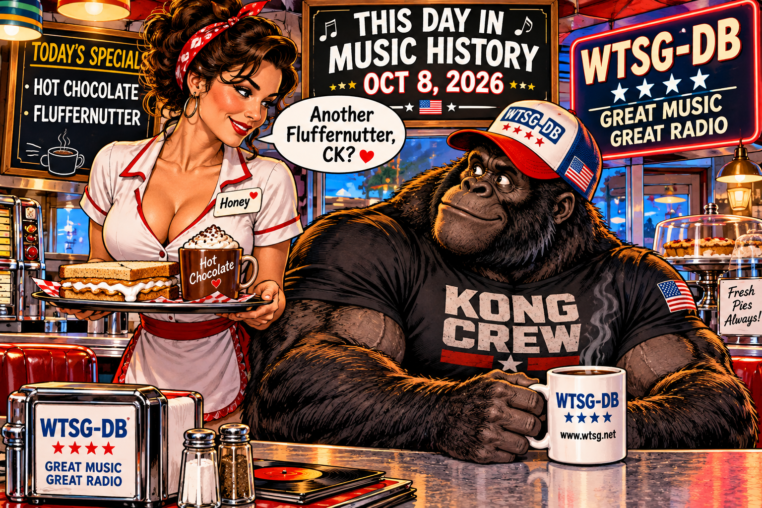
 Oct 8, 2026 – This Day in Music History
From the Desk of CLASSICKONG
Welcome back, music lovers, to another trip through the records, artists and moments that built the soundtrack of our lives.
Before we spin the first record, WTSG-DB proudly sends our thanks to the men and women of the United States Armed Forces—past and present—and to the families who stand beside them. Your service and sacrifice are never forgotten.
And that fits especially well today because October 8 is National Hero Day, a day set aside to recognize the everyday heroes who make a difference in the lives of others.
October 8 is also National Pierogi Day, American Touch Tag Day and—perhaps most importantly to anyone hanging around the WTSG-DB diner—National Fluffernutter Day.
Peanut butter and marshmallow creme between two slices of bread.
Somewhere, Honey is already asking CLASSICKONG if he wants another one.
Don’t answer that.
We’ve got music history to do.
And today the musical roads go everywhere.
Jerry Lee Lewis wrestles with his conscience while recording one of the wildest records in early rock and roll. The Beatles walk into Abbey Road with a song that isn’t even completely finished. We celebrate the men behind Hot Chocolate, Average White Band and Kool & the Gang, revisit one absolutely ridiculous week for rock music in 1988, and follow a musical trail from Soundgarden to Johnny Cash, Tom Petty and the Heartbreakers—and somehow all the way back to Average White Band.
Before we’re finished, we’ll also remember the lovely and talented Lynn Anderson and a record that seemed to come out of every radio in America when some of us were kids.
Let’s drop the needle.
1957 – Jerry Lee Lewis Sets the Piano on Fire
On October 8, 1957, Jerry Lee Lewis entered Sun Studio in Memphis and recorded the definitive version of “Great Balls of Fire” — single, 1957, Sun Records.
Written by Otis Blackwell and Jack Hammer, the record barely needs two minutes to make its point.
Piano.
Voice.
Rhythm.
Attitude.
And Jerry Lee Lewis.
But one of the most fascinating things about the session happened between takes.
Lewis had been raised in a deeply religious environment and genuinely struggled with whether the rock and roll music he was making was sinful.
During the session, that internal battle spilled into an extraordinary recorded discussion with Sun Records founder Sam Phillips.
Jerry Lee worried that the music might be leading him somewhere spiritually dangerous.
Phillips argued that music could instead be used for good.
It wasn’t some publicity stunt invented years later.
The tape was running.
Then Jerry Lee eventually sat back down at the piano.
And rock and roll history happened.
“Great Balls of Fire” became a massive crossover success and remains one of the defining recordings of the first generation of rock and roll.
But Jerry Lee’s story didn’t end when the original rock and roll explosion faded.
Far from it.
He reinvented himself as a major country artist during the late 1960s and continued making records for decades. Even after suffering a serious stroke in 2019, Lewis continued working on music.
In 2022, Jerry Lee and his cousin, evangelist Jimmy Swaggart, recorded the gospel album Jimmy Lee & Jerry Lee: The Boys from Ferriday. It was released only weeks before Lewis died.
Think about that career for a moment.
The man who recorded “Great Balls of Fire” in 1957 was still releasing music in 2022.
Sixty-five years.
Jerry Lee Lewis died October 28, 2022, at age 87.
The Killer kept making music almost all the way to the end.
CLASSICKONG MUST HAVES – Jerry Lee Lewis
Jerry Lee Lewis — 1958, Sun RecordsJerry Lee’s Greatest! — 1961, Sun RecordsAnother Place, Another Time — 1968, Smash RecordsShe Still Comes Around (To Love What’s Left of Me) — 1969, Smash RecordsThe Killer Rocks On — 1972, Mercury RecordsLast Man Standing — 2006, Artists FirstMean Old Man — 2010, VerveRock & Roll Time — 2014, VanguardJimmy Lee & Jerry Lee: The Boys from Ferriday — 2022, Jim Records
1964 – The Beatles Record “She’s a Woman”
On October 8, 1964, the Beatles entered EMI Studios at Abbey Road and recorded “She’s a Woman” — B-side of “I Feel Fine,” 1964, Parlophone in the UK and Capitol Records in the U.S.
And apparently Paul McCartney didn’t exactly arrive carrying a finished masterpiece under his arm.
Paul later remembered walking around St John’s Wood with the song in his head and essentially finishing it on the way to—and even inside—the studio.
John Lennon remembered that they arrived with only about a verse and had to finish the thing rather quickly.
Now THAT sounds like the Beatles.
There doesn’t appear to have been one particular woman who inspired the song. McCartney was instead reaching for a bluesy, R&B-flavored number and pushing his voice into the harder style he loved in singers such as Little Richard.
Then John Lennon supplied one of the ingredients that really makes the record work.
Instead of filling every available space with rhythm guitar, Lennon stabbed short chords on the off-beats.
That left room.
Ringo Starr supplied the pulse, McCartney’s bass could move around underneath, and George Harrison later added the lead guitar.
Paul also overdubbed piano.
The released recording grew from take six.
There’s another little piece of Beatles history hidden in the lyrics.
The phrase “turn me on” is generally regarded as one of the Beatles’ earliest explicit drug references. Bob Dylan had introduced the group to marijuana only weeks earlier, and Lennon later remembered their excitement at slipping the expression into a Beatles record without the censors catching it.
So what sounds on the surface like another Beatles love song actually captures the group in transition.
They were still Beatlemania’s lovable mop tops.
But things were already changing.
Musically.
Lyrically.
Culturally.
And within a couple of years, everything would change.
Not bad for a B-side they hadn’t even completely finished when they showed up for work.
CLASSICKONG MUST HAVES – The Beatles
Please Please Me — 1963, ParlophoneA Hard Day’s Night — 1964, ParlophoneRubber Soul — 1965, ParlophoneRevolver — 1966, ParlophoneSgt. Pepper’s Lonely Hearts Club Band — 1967, ParlophoneThe Beatles (White Album) — 1968, Apple RecordsAbbey Road — 1969, Apple RecordsLet It Be — 1970, Apple Records
Remembering Tony Wilson – The Man Behind Hot Chocolate
This one feels a little different this year.
Hot Chocolate co-founder Tony Wilson was born October 8, 1936, in Trinidad.
He died only a few months ago, on April 24, 2026, at age 89.
So today would have been Tony Wilson’s 90th birthday.
Wilson met Errol Brown in London during the late 1960s, and together they became the songwriting foundation behind Hot Chocolate.
And if somebody says Hot Chocolate and your brain immediately goes…
I believe in miracles…
Yep.
That’s “You Sexy Thing” — Hot Chocolate, 1975, RAK Records in the UK and Big Tree Records in the U.S.
Wilson co-wrote it with Brown.
He also co-wrote “Emma” — Cicero Park, 1974, RAK/Big Tree and “Brother Louie” — single, 1973, RAK Records, among other Hot Chocolate songs.
Wilson eventually left Hot Chocolate in 1975, but his fingerprints remained on some of the band’s most enduring music.
And today, less than six months after his passing, hearing those songs carries a little more weight.
RIP, Tony.
Thanks for the music.
And yes…
We still believe in miracles.
CLASSICKONG MUST HAVES – Hot Chocolate
Cicero Park — 1974, RAK/Big TreeHot Chocolate — 1975, RAK/Big TreeMan to Man — 1976, RAK/Big TreeEvery 1’s a Winner — 1978, RAK/InfinityGoing Through the Motions — 1979, RAK/InfinityClass — 1980, RAKMystery — 1982, RAK/EMI AmericaLove Shot — 1983, RAK
Happy Birthday Hamish Stuart – Average White Band
Born October 8, 1949, in Glasgow, Scotland, Hamish Stuart became one of the central voices, guitarists and bassists of the Average White Band.
Yes.
Scotland.
AWB sounded so completely at home playing American funk and soul that you could easily assume these guys grew up somewhere around Detroit, Memphis or Philadelphia.
Nope.
Scotland.
And around here, we LOVE us some AWB.
These guys could groove.
“Pick Up the Pieces” — AWB, 1974, Atlantic Records became a No. 1 hit in America, but don’t stop there.
There’s “Cut the Cake” — Cut the Cake, 1975, Atlantic Records, “School Boy Crush” — Cut the Cake, 1975, Atlantic Records, “A Love of Your Own” — Soul Searching, 1976, Atlantic Records, and “If I Ever Lose This Heaven” — AWB, 1974, Atlantic Records.
AWB had funk in its bloodstream.
Stuart’s career extended well beyond the band, too, including work with Chaka Khan, Aretha Franklin, David Sanborn, George Benson and Paul McCartney.
But here’s where today’s musical rabbit hole begins.
Average White Band drummer Steve Ferrone joined the group following the tragic death of original drummer Robbie McIntosh and spent years helping anchor one hell of a rhythm section.
Ferrone later entered Tom Petty’s orbit during the Wildflowers period and became the drummer for Tom Petty and the Heartbreakers following Stan Lynch’s departure.
Remember that name.
Steve Ferrone.
We’re going to find him again before today’s story is over.
CLASSICKONG MUST HAVES – Average White Band
AWB — 1974, Atlantic RecordsCut the Cake — 1975, Atlantic RecordsSoul Searching — 1976, Atlantic RecordsPerson to Person — 1977, Atlantic RecordsBenny and Us — 1977, Atlantic RecordsWarmer Communications — 1978, Atlantic RecordsFeel No Fret — 1979, Atlantic RecordsShine — 1980, Arista/RCA
If you’re only buying three, CLASSICKONG says start with AWB, Cut the Cake and Soul Searching.
Then good luck stopping.
Happy Birthday Robert “Kool” Bell – Kool & the Gang
Robert “Kool” Bell was born October 8, 1950.
Bass player.
Co-founder.
And one of the men responsible for a band that could move effortlessly between jazz, funk, R&B, dance music and beautiful pop ballads.
Kool & the Gang gave us “Jungle Boogie” — Wild and Peaceful, 1973, De-Lite Records, “Hollywood Swinging” — Wild and Peaceful, 1973, De-Lite Records, “Ladies’ Night” — Ladies’ Night, 1979, De-Lite Records, “Celebration” — Celebrate!, 1980, De-Lite Records, and “Get Down on It” — Something Special, 1981, De-Lite Records.
But there’s one Kool & the Gang record that will always occupy a special place around here.
“Cherish” — Emergency, 1984, De-Lite Records.
That’s my wife and I’s song.
But I’m sure we’re hardly alone.
Somewhere out there are countless couples who hear “Cherish” and immediately think of each other.
Maybe it played at their wedding.
Maybe it was on the radio during their first date.
Maybe it simply arrived at the right moment and became their song without anybody ever formally deciding that it was.
That’s what happens when a great love song stops belonging only to the people who recorded it.
It begins belonging to the people who live their lives with it.
For my wife and me, that’s “Cherish.”
For somebody reading this today, it may be yours too.
Happy birthday, Kool.
And thanks for helping give so many people a beautiful piece of the soundtrack of their lives.
CLASSICKONG MUST HAVES – Kool & the Gang
Wild and Peaceful — 1973, De-Lite RecordsLight of Worlds — 1974, De-Lite RecordsSpirit of the Boogie — 1975, De-Lite RecordsLadies’ Night — 1979, De-Lite RecordsCelebrate! — 1980, De-Lite RecordsSomething Special — 1981, De-Lite RecordsIn the Heart — 1983, De-Lite RecordsEmergency — 1984, De-Lite Records
And yes, Emergency belongs in the collection for “Cherish” alone.
1988 – One Hell of a Day for Rock and Roll
October 8, 1988.
Take a look at what was happening on the American charts.
Def Leppard had the No. 1 single.
Cheap Trick was sitting at No. 4.
Poison was at No. 12.
And Metallica was establishing itself as an album-chart force with …And Justice for All.
Rock music was everywhere.
Let’s start at the top.
Def Leppard – “Love Bites” Goes to Number One
Def Leppard reached No. 1 on the Billboard Hot 100 with “Love Bites” — Hysteria, 1987, Mercury Records.
It became the band’s first—and remains its only—No. 1 single in America.
And what an era.
Hysteria wasn’t simply successful.
It dominated.
The album produced seven singles, including “Women,” “Animal,” “Hysteria,” “Pour Some Sugar on Me,” “Armageddon It,” “Rocket” and “Love Bites” — Hysteria, 1987, Mercury Records.
Producer Robert John “Mutt” Lange and the band created something so layered and meticulously constructed that “Love Bites” initially presented another problem:
They hadn’t really played the thing together live.
When the song exploded, the band had to work out how to reproduce that heavily constructed studio recording onstage.
And because no CLASSICKONG discussion of Def Leppard can remain completely serious, we must pause for one of the great moments in Joe Dirt:
“Def Leppard sucks!”
ROFLMAO!
Sorry, Robby.
Around here, we respectfully disagree.
CLASSICKONG MUST HAVES – Def Leppard
High ‘n’ Dry — 1981, Mercury RecordsPyromania — 1983, Mercury RecordsHysteria — 1987, Mercury RecordsAdrenalize — 1992, Mercury RecordsRetro Active — 1993, Mercury Records
If you’re new to the band, Pyromania and Hysteria are mandatory.
Metallica – The Case of the Missing Bass Player
We’ve talked plenty of Metallica around here.
But …And Justice for All — 1988, Elektra Records deserves its own chair at the table.
This was the band’s first full studio album following the death of bassist Cliff Burton on September 27, 1986, and the first Metallica studio album featuring Jason Newsted.
Musically, Metallica was getting increasingly complex.
“Blackened,” “…And Justice for All,” “Harvester of Sorrow,” “Eye of the Beholder” and especially “One” — …And Justice for All, 1988, Elektra Records pushed the band beyond conventional thrash metal.
“One” also became the first Metallica song to receive an official music video.
But we can’t discuss this album without addressing one of the great mysteries—and controversies—in heavy-metal production.
Where the hell is Jason Newsted?
Newsted played bass on the album.
By all accounts, he played the parts.
But on much of the finished record, you’d need a search warrant to find him.
And nearly four decades later, the people involved still don’t completely agree about why.
Mix engineer Steve Thompson has said that Jason’s bass tracks sounded good and that Lars Ulrich specifically directed him to lower the bass dramatically in the mix.
Thompson has also said he wasn’t happy about it.
Lars has pushed back against the idea that burying Jason was some deliberate personal attack. His explanation has essentially been that the drums and James Hetfield’s massive rhythm-guitar sound kept being pushed until the bass simply lost its place in the sonic picture.
Kirk Hammett has likewise explained that Newsted’s bass occupied frequencies that competed heavily with Hetfield’s rhythm guitar.
Producer Flemming Rasmussen has offered thoughts of his own over the years.
So who’s right?
We weren’t standing behind the console in 1988.
And we’re not going to pretend we were.
There was also an enormous emotional elephant in the room.
Jason wasn’t simply replacing Metallica’s bass player.
He was replacing Cliff Burton, their friend and bandmate, who had died tragically less than two years earlier.
Whether that grief had any unconscious influence on how the band approached Jason or the final sound of the record is something we’ll probably never know.
What we DO know is this:
Jason heard the finished album.
And he was furious.
Years later he described being absolutely livid when he realized how little of his bass could be heard.
And here’s where the story becomes almost comical.
Metallica did remaster …And Justice for All in 2018.
But they didn’t remix it.
There’s a difference.
Remastering works with the existing finished mix and attempts to optimize its overall sound.
A remix would mean returning to the individual multitrack recordings—where Jason’s bass still exists—and actually changing the balance.
Turn Jason up.
Move the guitars.
Adjust the drums.
Create a new mix.
Metallica chose not to do that.
James Hetfield has defended leaving the record essentially as history remembers it: a snapshot of what Metallica was at that particular moment.
And here’s the greatest twist of all.
After being furious about it for years, Jason Newsted himself now says he doesn’t want the album officially remixed either.
Leave it alone.
That’s the record.
That’s history.
So let’s review.
Jason:
“Where the hell is my bass?”
Steve Thompson:
“Ask Lars.”
Lars:
“Sounds great!”
James:
“That’s the record we made.”
Jason, decades later:
“Don’t change it.”
Metallica fans:
WHAT IS WRONG WITH ALL OF YOU?!
ROFLMAO!
Whatever you think of the production, …And Justice for All remains one ferocious album.
But if you happen to own a bass guitar…
You may want to play along.
Apparently there’s room.
CLASSICKONG MUST HAVES – Metallica
Kill ‘Em All — 1983, Megaforce RecordsRide the Lightning — 1984, Megaforce/ElektraMaster of Puppets — 1986, Elektra Records…And Justice for All — 1988, Elektra RecordsMetallica — 1991, Elektra Records
Five records.
One hell of a run.
Poison – “Fallen Angel”
Also on October 8, 1988, Poison’s “Fallen Angel” — Open Up and Say… Ahh!, 1988, Enigma/Capitol Records sat at No. 12 on the Billboard Hot 100.
Poison was everywhere during this period.
Radio.
MTV.
Magazines.
Posters.
You couldn’t miss these guys if you tried.
The classic Poison lineup was:
Bret Michaels — lead vocalsC.C. DeVille — lead guitar and backing vocalsBobby Dall — bass and backing vocalsRikki Rockett — drums, percussion and backing vocals
Open Up and Say… Ahh! also gave us “Nothin’ but a Good Time,” “Every Rose Has Its Thorn” and their cover of “Your Mama Don’t Dance” — Open Up and Say… Ahh!, 1988, Enigma/Capitol Records.
Was Poison subtle?
Absolutely not.
That was kind of the point.
CLASSICKONG MUST HAVES – Poison
Look What the Cat Dragged In — 1986, Enigma RecordsOpen Up and Say… Ahh! — 1988, Enigma/Capitol RecordsFlesh & Blood — 1990, Enigma/Capitol Records
Cheap Trick – Elvis Gets the Cheap Trick Treatment
Meanwhile, one of our longtime favorites was having quite a day too.
Cheap Trick’s cover of “Don’t Be Cruel” — Lap of Luxury, 1988, Epic Records was sitting at No. 4 on the Billboard Hot 100.
Yes.
Cheap Trick covering Elvis.
We’ll take it.
And Lap of Luxury had already produced the band’s only U.S. No. 1 single, “The Flame” — Lap of Luxury, 1988, Epic Records.
There’s another important piece of the story.
Lap of Luxury marked bassist Tom Petersson’s return to Cheap Trick after leaving the band in 1980.
So the lineup was once again:
Robin Zander — lead vocals and rhythm guitarRick Nielsen — lead guitar and backing vocalsTom Petersson — bass and backing vocalsBun E. Carlos — drums and percussion
The classic Cheap Trick lineup was back together.
And suddenly they were sitting near the top of the singles chart again.
We’ve said it before around here.
We love us some Cheap Trick.
CLASSICKONG MUST HAVES – Cheap Trick
Cheap Trick — 1977, Epic RecordsIn Color — 1977, Epic RecordsHeaven Tonight — 1978, Epic RecordsCheap Trick at Budokan — 1979, Epic RecordsDream Police — 1979, Epic RecordsLap of Luxury — 1988, Epic Records
And yes.
At Budokan is mandatory.
1991 – Soundgarden Releases Badmotorfinger
On October 8, 1991, Soundgarden released Badmotorfinger on A&M Records.
Now we’re getting heavy.
Chris Cornell — vocals and rhythm guitarKim Thayil — lead guitarBen Shepherd — bassMatt Cameron — drums
This was the first Soundgarden album featuring Shepherd on bass, completing what many fans consider the classic Soundgarden lineup.
And what an album.
“Rusty Cage,” “Outshined” and “Jesus Christ Pose” — Badmotorfinger, 1991, A&M Records helped introduce a much wider audience to a band that could be brutally heavy, strange, intelligent and almost impossible to pigeonhole.
Cornell possessed an extraordinary voice.
Thayil’s guitar work frequently sounded like somebody had taken heavy metal apart and reassembled it incorrectly—in the best possible way.
Matt Cameron?
Monster drummer.
And “Rusty Cage” gives us today’s greatest musical rabbit hole.
Because five years later…
Johnny Cash recorded it.
The Rabbit Hole – Soundgarden to Johnny Cash to Tom Petty to Average White Band
Johnny Cash recorded Chris Cornell’s “Rusty Cage” for Unchained, 1996, American Recordings, produced by Rick Rubin.
And Cash didn’t simply imitate Soundgarden.
He turned it into Johnny Cash music.
Backing him on Unchained?
Tom Petty and the Heartbreakers.
That’s right.
Tom Petty, Mike Campbell, Benmont Tench, Howie Epstein and drummer Steve Ferrone formed the core backing band, with additional musicians appearing on individual tracks.
Wait a minute.
Steve Ferrone?
Yep.
The Average White Band drummer we talked about earlier.
We’ve gone all the way around the block.
Hamish Stuart → Average White Band → Steve Ferrone → Tom Petty and the Heartbreakers → Johnny Cash → “Rusty Cage” → Chris Cornell → Soundgarden.
Now THAT is why music history is fun.
Rubin’s first Cash collaboration, American Recordings — 1994, American Recordings, had largely stripped Johnny down to voice and guitar.
Unchained put one of America’s great rock and roll bands behind him.
And the Heartbreakers did exactly what great musicians should do.
They served the song.
No unnecessary fireworks.
No attempt to make Johnny Cash sound like Tom Petty.
They simply helped Johnny Cash sound like Johnny Cash.
That’s musicianship.
Johnny Cash died September 12, 2003, at age 71.
Chris Cornell died May 18, 2017, at age 52.
Tom Petty died October 2, 2017, at age 66.
Three extraordinary voices.
Gone much too soon.
CLASSICKONG MUST HAVES – Soundgarden
Ultramega OK — 1988, SST RecordsLouder Than Love — 1989, A&M RecordsBadmotorfinger — 1991, A&M RecordsSuperunknown — 1994, A&M RecordsDown on the Upside — 1996, A&M RecordsKing Animal — 2012, Seven Four/Republic Records
Start with Badmotorfinger and Superunknown.
Turn them up.
1970 – Lynn Anderson Gives Us a “Rose Garden”
And finally, we slow things down for one of those records that can transport you back to childhood almost instantly.
On October 8, 1970, Lynn Anderson released the single “Rose Garden” — Columbia Records.
The Rose Garden album followed in December 1970 on Columbia.
Written by Joe South, the song had already been recorded by other artists, but Lynn Anderson made it hers.
Anderson had discovered the song through Joe South and wanted to record it.
Her producer—and then-husband—Glenn Sutton wasn’t convinced.
He believed some of the lyrics worked better coming from a man’s perspective.
Lynn kept pushing.
Good call.
When Columbia executive Clive Davis heard the finished recording, he recognized what Sutton hadn’t initially heard.
A hit.
And was it ever.
“Rose Garden” became a No. 1 country record, crossed all the way to No. 3 on the Billboard Hot 100 and became an enormous international success.
Lynn won the Grammy Award for Best Female Country Vocal Performance.
And for those of us who were kids when it arrived, this wasn’t simply another country record.
It seemed to be everywhere.
Radio.
Television.
Stores.
Cars.
You heard that arrangement and knew immediately what was coming.
For years afterward, Lynn Anderson sometimes seemed in the public imagination like the woman who appeared, gave the world this enormous record and then disappeared.
But she didn’t.
She continued placing songs on the country charts throughout the 1970s, including “You’re My Man” — You’re My Man, 1971, Columbia Records, “How Can I Unlove You” — How Can I Unlove You, 1971, Columbia Records, and “What a Man My Man Is” — What a Man My Man Is, 1974, Columbia Records.
Her life outside music was remarkable too.
Lynn was an accomplished horsewoman who won numerous national and world championships.
Sadly, Lynn Anderson died July 30, 2015, at only 67 years old after suffering a heart attack following hospitalization with pneumonia.
Sixty-seven.
Much too young.
So today we’re not going to dwell on how Lynn left us.
We’re going to remember that beautiful voice, that unmistakable smile and a record that once seemed to be coming out of every radio in America.
RIP, Lynn.
Thanks for the roses.
CLASSICKONG MUST HAVES – Lynn Anderson
Ride, Ride, Ride — 1967, Chart RecordsPromises, Promises — 1968, Chart RecordsAt Home with Lynn — 1969, Chart RecordsI’m Alright — 1970, Chart RecordsNo Love at All — 1970, Columbia RecordsRose Garden — 1970, Columbia RecordsYou’re My Man — 1971, Columbia RecordsHow Can I Unlove You — 1971, Columbia RecordsWhat a Man My Man Is — 1974, Columbia RecordsThe Bluegrass Sessions — 2004, DM RecordsBridges — 2015, Center Sound Records
If you’re buying one?
You already know.
Rose Garden.
Final Spin
There’s a funny thing about music.
The people making these records rarely know where they’re eventually going to end up.
Jerry Lee Lewis couldn’t have known in 1957 that people would still be talking about that afternoon at Sun Studio nearly seventy years later.
The Beatles probably didn’t imagine that a B-side they were still finishing when they walked into the studio would be dissected by music lovers generations later.
Tony Wilson couldn’t have known how many people would still smile when they heard those opening notes from Hot Chocolate.
And Kool & the Gang couldn’t possibly have known how many couples would eventually hear “Cherish” and say:
That’s our song.
Maybe that’s the real magic.
A record begins as musicians standing in a room.
Then it leaves them.
It finds a radio.
A car.
A bedroom.
A wedding.
A kid hearing Lynn Anderson coming through the speakers.
A drummer listening to Steve Ferrone lock into a groove.
Someone discovering Soundgarden.
Someone rediscovering Johnny Cash.
Someone wondering where the hell Jason Newsted’s bass went.
And somewhere along the way, the music stops belonging only to the musicians who made it.
It becomes part of our story.
Maybe that’s why we keep coming back.
Not just because we remember the songs.
Because the songs remember us.
Until tomorrow, take care of yourself, help others when you can, and always keep the music playing.
We’ll see ya down the road!
— CLASSICKONG
Listen to Today’s Broadcast/Podcast
Prefer to listen instead of read?
Join CLASSICKONG for today’s spoken-word edition of This Day in Music History on WTSG-DB, where we bring the stories, songs and connections behind October 8 to life.
Great Music. Great Radio.
WTSG-DB
References
History — Jerry Lee Lewis Records “Great Balls of Fire”
Country Music Hall of Fame — Jerry Lee Lewis
The Beatles Bible — “She’s a Woman” Song History
The Beatles Bible — October 8, 1964: Recording “She’s a Woman”
The Guardian — Tony Wilson Obituary
National Day Calendar — October 8
Average White Band — Official Website
Steve Ferrone — Official Website and Biography
Kool & the Gang — Official Website
Def Leppard — Official Website
Def Leppard UK — October 8, 1988: “Love Bites” Reaches No. 1
Metallica — Official …And Justice for All Album Page
Metallica — …And Justice for All Remastered Deluxe Box Set
Soundgarden — Official Badmotorfinger Album Page
AllMusic — Badmotorfinger Release Information
Johnny Cash — Official Website