
 Written by
 From the Desk of CLASSICKONG
Welcome back, music lovers, to another trip through the records, artists and moments that built the soundtrack of our lives.
Before we spin the first record, WTSG-DB proudly sends our thanks to the men and women of the United States Armed Forces—past and present—and to the families who stand beside them. Your service and sacrifice are never forgotten.
September 25 turned out to be one of those days where the deeper we dug, the more the music started talking to itself.
We’ve got a one-hit wonder whose message from 1965 still resonates more than six decades later. We’ve got a Beatle going country because a Nashville legend happened to look inside his car. Black Sabbath gives us two albums on the same date. Tears for Fears tells us to “Shout.” INXS asks “What You Need.” And The J. Geils Band responds:
“Give It to Me!”
And somewhere along the way, Nile Rodgers shows up again.
Of course he does.
Let’s spin it.
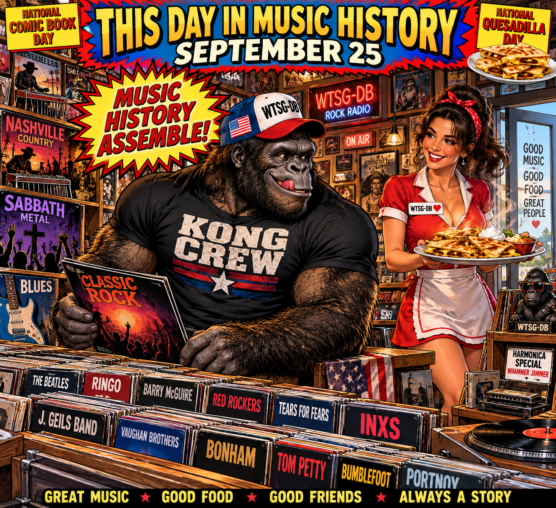
NATIONAL DAYS — SEPTEMBER 25
National One-Hit Wonder Day
This one gets pole position because we’re a music site, and September 25 gives us an almost unbelievable connection to celebrate it.
We’ll get to Barry McGuire shortly, because on this very date in 1965, his one enormous solo hit, “Eve of Destruction,” sat at No. 1 in America.
Sometimes one record is all it takes.
National Quesadilla Day
Cheese. Tortilla. Heat.
I’m not sure this requires extensive historical analysis.
CLASSICKONG APPROVED.
National Comic Book Day
Now THIS one was practically custom-made for CLASSICKONG!
And amazingly, September 25 gives us a perfect musical connection.
1965 — THE BEATLES BECOME CARTOONS
On September 25, 1965, The Beatles animated television series premiered on ABC in the United States.
The series eventually produced 39 episodes over three seasons, with stories built around Beatles songs. The premiere featured “A Hard Day’s Night” and “I Want to Hold Your Hand.”
Here’s the fun part:
John, Paul, George and Ringo did not provide their own speaking voices.
American actor Paul Frees voiced John Lennon and George Harrison, while British actor Lance Percival handled Paul McCartney and Ringo Starr.
Producer Al Brodax would later become involved with another little animated Beatles project you may have heard of:
Yellow Submarine.
National Comic Book Day and animated Beatles on the same date?
We’ll take it.
Collector’s Note
For Beatles fans wondering whether they can buy the series today, unfortunately there is no current authorized complete-series DVD or Blu-ray edition in print.
Legitimate home-video editions were issued years ago, including releases from MPI Home Video, and vintage copies occasionally turn up on the secondary market.
So if you’ve never seen the Beatles cartoons and want an official physical copy, this is one where collectors have to do some digging.
1965 — BARRY McGUIRE: “EVE OF DESTRUCTION”
On the Billboard Hot 100 dated September 25, 1965, Barry McGuire’s “Eve of Destruction” reached No. 1.
Written by P.F. Sloan and released on Dunhill Records, this was not exactly lightweight pop.
The song looked at a world filled with war, nuclear anxiety, racial conflict, political tension and social unrest. One of its most pointed observations concerned young American men being old enough to be drafted while still not being old enough to vote.
And here’s something else that caught my attention:
Hal Blaine played drums. Larry Knechtel played bass.
There are those Wrecking Crew guys again.
“Eve of Destruction” became Barry McGuire’s only U.S. Top 40 solo hit.
So think about this:
September 25 — National One-Hit Wonder Day.
And on September 25, 1965, one of rock’s most memorable one-hit wonders was sitting at No. 1 in America.
You couldn’t plan that any better.
But today’s research gave me a personal surprise.
When we started talking about the song, I kept thinking:
Wait a minute. I know “Eve of Destruction,” but I don’t remember Barry McGuire’s version.
The version playing in my head had a distinctly ’80s pop-punk/new-wave sound.
After a little digging, mystery solved:
Red Rockers.
They remade “Eve of Destruction” on their 1984 album Schizophrenic Circus.
As soon as I played it again, there it was.
That’s the version I remembered.
And I’ve got to tell you—I like that recording even more today than I remembered liking it then. In fact, our research sent me back into the Red Rockers catalog, and now I’m looking forward to exploring those records again.
That’s one of the things I love about music history.
Sometimes you go looking for the past…
and the past finds you.
There’s another interesting aspect to this song in 2026.
“Eve of Destruction” was written more than 60 years ago, yet news reports today still regularly discuss wars, nuclear tensions, racial and social divisions and political unrest around the world.
The circumstances aren’t identical, and history never repeats itself perfectly.
But the fact that a song written in 1965 can still make a listener stop and think in 2026 says something about the staying power of both the record and the questions it raised.
Must-Have Discogs
Barry McGuire — Eve of Destruction1965 • Dunhill Records
Red Rockers — Schizophrenic Circus1984 • 415/Columbia
And if today’s rediscovery sends you looking for more Red Rockers, don’t overlook Good as Gold from 1983, home of “China.”
1970 — WHY DID RINGO GO COUNTRY?
On September 25, 1970, Ringo Starr released Beaucoups of Blues in the UK on Apple Records. The American release followed on September 28.
This was Ringo’s second solo studio album.
And it’s COUNTRY.
So naturally I had a question:
Why?
Turns out there’s a terrific answer.
Ringo had loved country music since his youth in Liverpool. Because Liverpool was a major port, sailors returning from America brought records with them—country, blues and other American music that could be difficult to find elsewhere in Britain.
And we’d already heard Ringo’s affection for country within the Beatles. Think about him singing Buck Owens’ “Act Naturally” or writing “Don’t Pass Me By.”
Years later, while Ringo was working with George Harrison, he met legendary Nashville pedal-steel guitarist Pete Drake, who had played on Bob Dylan’s Nashville Skyline.
Ringo sent his car to pick Drake up at Heathrow Airport.
Drake noticed all the country music in Ringo’s car.
He basically said:
You like country music. Come to Nashville and make a country record.
Ringo initially thought that meant disappearing to Nashville for a month.
Drake explained that they could make records considerably faster than that.
Ringo was sold.
He went to Nashville, and Beaucoups of Blues was recorded at Music City Recorders in a remarkably concentrated series of sessions.
Pete Drake produced it and surrounded Ringo with Nashville talent that included musicians such as Charlie Daniels, Charlie McCoy, Ben Keith and D.J. Fontana.
Ringo finally got to make an entire record in a style he’d loved long before Beatlemania existed.
Now THAT explains the record.
And I love knowing it.
Must-Have Discogs — Ringo Starr
Ringo Starr — Beaucoups of Blues1970 • Apple Records
Ringo Starr — Ringo1973 • Apple RecordsThe big one: “Photograph,” “You’re Sixteen,” “Oh My My”—and contributions from all three of his former Beatles bandmates.
Ringo Starr — Goodnight Vienna1974 • Apple RecordsAnother strong ’70s Ringo album, featuring the title track written by John Lennon.
BLACK SABBATH × 2 — SAME DATE, FOUR YEARS APART
September 25 belongs to Black Sabbath twice.
Vol. 4 — 1972 • Warner Bros.
Released September 25, 1972, Vol. 4 contains:
“Wheels of Confusion”“Changes”“Supernaut”“Snowblind”“Laguna Sunrise”“Under the Sun”
Recorded at the Record Plant in Los Angeles, Vol. 4 demonstrated that Sabbath could remain crushingly heavy while stretching beyond the boundaries they’d established on their first three albums.
And “Supernaut”?
That riff alone ought to require a building permit.
Technical Ecstasy — 1976 • Warner Bros.
Exactly four years later, on September 25, 1976, Technical Ecstasy received its U.S. release. The UK release followed October 8.
Different period.
Different Sabbath record.
But there are gems here:
“Back Street Kids”“You Won’t Change Me”“Rock ‘n’ Roll Doctor”“Dirty Women”
And drummer Bill Ward sings lead vocals on “It’s Alright.”
As a drummer myself, I’ve always appreciated Bill Ward. Sabbath needed enormous power behind Ozzy, Tony Iommi and Geezer Butler, but Ward wasn’t simply pounding away back there.
He played the music.
That’s what a drummer is supposed to do.
Serve the song. Drive the machine!
Must-Have Discogs
Black Sabbath — Vol. 41972 • Warner Bros.
Black Sabbath — Technical Ecstasy1976 • Warner Bros.
1974 — THE J. GEILS BAND: THEY MADE ROCK & ROLL A GOOD TIME
On September 25, 1974, The J. Geils Band released Nightmares…and Other Tales from the Vinyl Jungle on Atlantic Records.
Produced by Bill Szymczyk, the album contains one of the band’s great ’70s records:
“Must of Got Lost.”
It eventually reached No. 12 on the Billboard singles chart.
But I want to say something about J. Geils and this band beyond numbers.
The J. Geils Band made rock & roll a good time.
There was a period when rock radio seemed absolutely overflowing with bands that brought personality, musicianship and FUN through the speakers.
J. Geils Band.
The Knack.
Golden Earring.
Sniff ‘n’ the Tears.
Greg Kihn Band.
Red Rockers.
And so many others.
Different sounds. Different styles.
But fun didn’t mean shallow.
These guys could play.
And The J. Geils Band could REALLY play.
They had blues and R&B underneath everything, tremendous live energy, J. Geils on guitar, Peter Wolf out front, Seth Justman on keyboards, Danny Klein on bass, Stephen Jo Bladd behind the drums…
…and then there was harmonica player Richard “Magic Dick” Salwitz.
Yep.
Magic Dick.
That’s really his stage name.
I’m just reporting the history, people.
Don’t shoot the gorilla.
His harmonica work—particularly the instrumental showcase “Whammer Jammer”—became an essential part of the J. Geils Band sound.
And that band earned a reputation as an absolutely ferocious live act.
Years later, when I learned that J. Geils had died, it hit me surprisingly hard.
I’d never met him.
But his music had been there throughout my youth and high-school years.
That’s the strange and beautiful thing about music.
An artist doesn’t have to know you personally to become part of your life.
Sometimes when we lose one of them, we’re suddenly reminded of all the years their music traveled alongside us.
John Warren Geils Jr.Born: February 20, 1946Died: April 11, 2017Age: 71
Give J. his roses.
He earned them.
SUPER-HERO TRADING CARD — J. GEILS
REAL NAME: John Warren Geils Jr.
BORN: February 20, 1946 — New York City
DIED: April 11, 2017 — Groton, Massachusetts
WEAPON OF CHOICE: Guitar
SUPERPOWER: Turning blues, R&B, soul and rock & roll into a full-throttle live experience.
SUPERWEAPON: THE ROCK & ROLL FUN GUN!
SECRET WEAPON: A band built to bring the party to the stage.
ALLIES: Peter Wolf • Magic Dick • Seth Justman • Danny Klein • Stephen Jo Bladd
BATTLE CRIES: “Must of Got Lost” • “Give It to Me” • “Love Stinks” • “Freeze-Frame” • “Centerfold”
CLASSICKONG RATING: LEGEND.
Must-Have Discogs
The J. Geils Band — “Live” Full House1972 • Atlantic Records
The J. Geils Band — Nightmares…and Other Tales from the Vinyl Jungle1974 • Atlantic Records
The J. Geils Band — Love Stinks1980 • EMI America
The J. Geils Band — Freeze-Frame1981 • EMI America
If you want to understand why people talk about this band as a live powerhouse, “Live” Full House is required listening.
1989 — TEARS FOR FEARS PLANT THE SEEDS OF LOVE
On September 25, 1989, Tears for Fears released The Seeds of Love on Fontana/Mercury.
Four years had passed since Songs from the Big Chair turned Roland Orzabal and Curt Smith into international stars.
And I absolutely love Tears for Fears.
“Shout” is one of my absolute favorite songs they’ve ever recorded.
That song came from Songs from the Big Chair, not The Seeds of Love, but it’s worth mentioning because it demonstrates just how enormous the expectations were for whatever came next.
And there’s another reason “Shout” fits today’s story.
It wasn’t merely a giant ’80s anthem. Roland Orzabal has described it as a protest song, while Curt Smith has discussed the broader idea of encouraging people to question things rather than simply accepting what they’re handed.
Sound familiar?
On the same September 25 journey where we’ve already encountered “Eve of Destruction,” suddenly “Shout” enters the conversation.
Sometimes these blogs really do connect themselves.
The Seeds of Love answered the enormous success of Songs from the Big Chair with something more ambitious and organic.
“Sowing the Seeds of Love.”
“Woman in Chains.”
“Advice for the Young at Heart.”
And then there’s Oleta Adams.
Her presence—particularly alongside Orzabal on “Woman in Chains”—helped give this record a soul and gospel dimension quite different from what many listeners expected from Tears for Fears.
Must-Have Discogs
Tears for Fears — Songs from the Big Chair1985 • Mercury
Tears for Fears — The Seeds of Love1989 • Fontana/Mercury
1990 — INXS: THEY WERE HUGE
On September 25, 1990, INXS released their seventh studio album, X.
1990 • Atlantic Records (U.S.) • Produced by Chris Thomas
The title wasn’t random.
X = 10.
It marked ten years since INXS had released their debut album.
But let’s put this record into proper perspective.
By 1990, INXS weren’t merely a successful Australian rock band.
They were HUGE.
Listen Like Thieves had given America “What You Need.”
Then Kick arrived.
“Need You Tonight.”
“Devil Inside.”
“New Sensation.”
“Never Tear Us Apart.”
Those songs were everywhere, and Michael Hutchence had become one of rock’s most recognizable frontmen.
So when X arrived, the world was waiting.
And INXS delivered:
“Suicide Blonde”“Disappear”“By My Side”“Bitter Tears”
The album reached No. 5 in the United States, No. 2 in Britain and No. 1 in Australia.
Must-Have Discogs
INXS — Listen Like Thieves1985 • Atlantic Records
INXS — Kick1987 • Atlantic Records
INXS — X1990 • Atlantic Records
And after everything we’ve talked about today, INXS asks a very important question:
“What You Need?”
Hold that thought.
1990 — THE VAUGHAN BROTHERS: FAMILY STYLE
Also released September 25, 1990:
Family Style by The Vaughan Brothers — Jimmie Vaughan and Stevie Ray Vaughan.
1990 • Epic Records
This one means something to me.
I bought the CD when it came out.
Stevie Ray Vaughan had died on August 27, 1990, less than a month before the album’s scheduled release. Importantly, the September 25 release date had already been established before Stevie’s death.
This wasn’t intended as a farewell album.
It was supposed to be something much happier:
two brothers finally making a record together.
I listened to Family Style a lot after Stevie died.
And one song always felt especially eerie afterward:
“Tick Tock.”
The song was written by Jimmie Vaughan, Jerry Lynn Williams and—wouldn’t you know it—Nile Rodgers.
NILE!
THERE HE IS AGAIN!
At this point we’re going to have to start a recurring WTSG-DB feature:
WHERE IN THE WORLD IS NILE RODGERS?
Apparently the answer is:
EVERYWHERE.
But underneath the joke is something that has stayed with me.
“Tick Tock” deals with time and the hope for a better, more compassionate world.
Hearing that after Stevie’s death gave the song a weight nobody could possibly have planned when the brothers recorded it.
That’s what music does sometimes.
The circumstances around a song change…
and suddenly you hear it differently forever.
Must-Have Discogs — Both Sides of the Vaughan Family
The Vaughan Brothers — Family Style1990 • Epic Records
Stevie Ray Vaughan and Double Trouble — Texas Flood1983 • Epic Records
Stevie Ray Vaughan and Double Trouble — Couldn’t Stand the Weather1984 • Epic Records
The Fabulous Thunderbirds — Tuff Enuff1986 • CBS Associated Records
That last one gives us Jimmie’s side of the family—and the monster title track “Tuff Enuff.”
BIRTHDAY SPINS
Sam Rivers
Born: September 25, 1923Died: December 26, 2011Age: 88
Saxophonist, flutist, composer and multi-instrumentalist Sam Rivers became an important figure in adventurous modern jazz.
His association with Blue Note Records produced records that could move between hard bop and much freer territory without losing musical purpose.
And there’s a connection that immediately gets my attention:
Tony Williams.
Rivers worked with Williams, and anytime Tony Williams enters the conversation, I’m listening.
Must-Have Discogs
Sam Rivers — Fuchsia Swing Song1965 • Blue Note Records
Sam Rivers — Contours1967 • Blue Note Records
✍️ Shel Silverstein
Born: September 25, 1930Died: May 10, 1999Age: 68
Most people immediately think of Shel Silverstein as the writer and illustrator behind books including The Giving Tree.
But Shel was also one hell of a songwriter.
And one of his songs became an enormous Johnny Cash record:
“A Boy Named Sue.”
Cash’s recording became a No. 2 Billboard Hot 100 hit and won Silverstein a Grammy.
Silverstein also wrote songs recorded by Dr. Hook and many others.
The guy had range.
Children’s author.
Cartoonist.
Poet.
Songwriter.
And somewhere Johnny Cash is still explaining why his daddy named him Sue.
Must-Have Discogs
Johnny Cash — At San Quentin1969 • Columbia Records
That’s where you’ll find the legendary live recording of “A Boy Named Sue.”
Burleigh Drummond
Born: September 25, 1951
Happy birthday to Burleigh Drummond, drummer, percussionist, vocalist and founding member of Ambrosia.
Now we’re talking.
Ambrosia could move from progressive rock into beautifully crafted pop without losing the musicianship underneath it.
“Holdin’ on to Yesterday.”
“How Much I Feel.”
“Biggest Part of Me.”
“You’re the Only Woman.”
And sitting behind that music was Burleigh Drummond—doing exactly what a great drummer should do:
Serving the song and driving the machine.
Must-Have Discogs
Ambrosia — Ambrosia1975 • 20th Century Records
Ambrosia — Life Beyond L.A.1978 • Warner Bros. Records
Ambrosia — One Eighty1980 • Warner Bros. Records
Ron “Bumblefoot” Thal
Born: September 25, 1969
Happy birthday to one seriously accomplished guitarist.
Bumblefoot has built a career around tremendous technique while remaining difficult to pigeonhole.
And let’s clear up an interesting bit of Guns N’ Roses history.
When Bumblefoot joined Guns N’ Roses in 2006, he wasn’t actually Slash’s direct replacement.
Slash had already been gone for about a decade.
Several guitarists had moved through the post-Slash world of Guns N’ Roses, and Bumblefoot came aboard specifically following the departure of Buckethead.
He then became part of the long and complicated journey toward Chinese Democracy.
The album finally appeared in 2008, and Bumblefoot contributed guitar—including his distinctive fretless guitar—to the finished record.
Then there’s another Bumblefoot connection that gets my attention immediately:
Mike Portnoy.
Bumblefoot later joined Sons of Apollo, alongside:
Mike Portnoy — drumsBilly Sheehan — bassDerek Sherinian — keyboardsJeff Scott Soto — vocals
Now THAT is some serious firepower.
Portnoy and Bumblefoot in the same band?
Yeah. I’m listening.
Must-Have Discogs — Bumblefoot / Sons of Apollo
Bumblefoot — Normal2005 • Bumblefoot Music
Guns N’ Roses — Chinese Democracy2008 • Geffen Records
Sons of Apollo — Psychotic Symphony2017 • Inside Out Music
Sons of Apollo — Live with the Plovdiv Psychotic Symphony2019 • Inside Out Music
Sons of Apollo — MMXX2020 • Inside Out Music
REMEMBERING JOHN BONHAM
John Henry BonhamBorn: May 31, 1948Died: September 25, 1980Age: 32
Today we remember John Bonham.
We don’t need to dwell on the circumstances of his death.
I’d rather talk about what happened when Bonzo sat behind a drum kit.
Power gets mentioned first, and understandably so.
But Bonham wasn’t great simply because he could hit hard.
Listen to the groove.
Listen to the space.
Listen to that right foot.
Listen to how enormous the drums sound without Bonham constantly trying to prove how many notes he could play.
“Good Times Bad Times.”
“When the Levee Breaks.”
“Rock and Roll.”
“Kashmir.”
“Fool in the Rain.”
Different feels.
Different demands.
Same drummer.
For generations of rock drummers, John Bonham remains part of the vocabulary.
Must-Have Discogs
Led Zeppelin — Led Zeppelin II1969 • Atlantic Records
Led Zeppelin — Led Zeppelin IV1971 • Atlantic Records
Led Zeppelin — Physical Graffiti1975 • Swan Song
Rest easy, Bonzo.
2017 — TOM PETTY’S FINAL CONCERT
On September 25, 2017, Tom Petty and the Heartbreakers took the stage at the Hollywood Bowl in Los Angeles for the final night of their 40th Anniversary Tour.
Nobody in that audience knew it would become Tom’s final concert.
The set included:
“I Won’t Back Down.”
“Free Fallin’.”
“Breakdown.”
“Learning to Fly.”
“Refugee.”
“Runnin’ Down a Dream.”
Then came the encore.
“You Wreck Me.”
And finally:
“American Girl.”
The song that appeared on the Heartbreakers’ first album became the final song Tom Petty ever performed in concert.
Petty died on October 2, 2017, at age 66.
I’ve always loved Tom Petty.
So rather than make this about sadness, I’ll remember what that Hollywood Bowl audience received that night:
Tom Petty and the Heartbreakers doing what they’d done for four decades.
Playing rock & roll.
Must-Have Discogs
Tom Petty and the Heartbreakers — Tom Petty and the Heartbreakers1976 • Shelter Records
Tom Petty and the Heartbreakers — Damn the Torpedoes1979 • Backstreet/MCA
Tom Petty — Full Moon Fever1989 • MCA Records
THE FINAL SPIN
Funny how today’s music started talking to itself.
Barry McGuire looked around and warned of an “Eve of Destruction.”
Years later, Tears for Fears told us to “Shout.”
INXS stepped in and asked:
“What You Need?”
And somewhere across the room, The J. Geils Band immediately yelled:
“GIVE IT TO ME!”
That sounds about right.
Then the Vaughan Brothers brought us back to something a little deeper:
“Tick Tock.”
Because through all the noise, uncertainty, laughter, loss, rediscovery and great records, one thing never changes.
Time keeps moving.
Maybe that’s why these old records can mean even more to us as the years pass. They don’t simply remind us of songs we loved.
They remind us where we were, who we were with, and sometimes even who we were becoming when we first heard them.
Today we rediscovered the Red Rockers. We learned why Ringo Starr went to Nashville. We celebrated two Black Sabbath records born on the same date. We remembered why J. Geils Band made rock & roll such a good time. We found Bumblefoot hanging out with Mike Portnoy. And we remembered musicians and songs that have traveled alongside us for decades.
That’s what makes digging through music history worthwhile.
The dates tell us when something happened.
The music reminds us why we still care.
So turn it up.
Rediscover something.
Find a record you’ve never heard before.
And if somebody asks you “What You Need?”
Well…
maybe J. Geils already gave us the answer.
Give It to Me.
Until tomorrow, keep the records spinning.
Pals Forever.
— CLASSICKONGWTSG-DB
REFERENCES
The Beatles Animated Serieshttps://www.beatlesbible.com/1965/09/25/beatles-cartoon-series-begins-united-states/
Barry McGuire — “Eve of Destruction”https://www.billboard.com/
Ringo Starr / Country Music Historyhttps://www.ringostarr.com/
Black Sabbath — Official Discographyhttps://www.blacksabbath.com/
The J. Geils Band / J. Geilshttps://www.allmusic.com/artist/the-j-geils-band-mn0000071207
Tears for Fearshttps://tearsforfears.com/
INXS — Official Sitehttps://www.inxs.com/
Stevie Ray Vaughan / The Vaughan Brothershttps://srvarchive.com/
Bumblefoot — Official Biographyhttps://bumblefoot.com/
Sons of Apollohttps://www.sonsofapollo.com/
Sam Rivers — Blue Note Recordshttps://www.bluenote.com/
Tom Petty — Official Sitehttps://www.tompetty.com/